
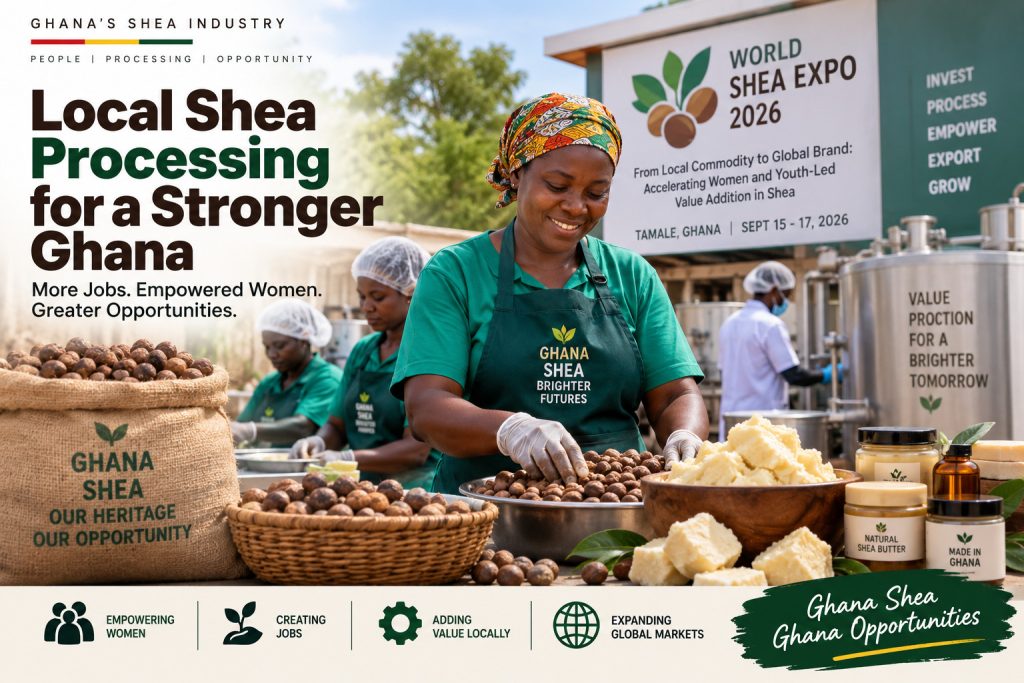
Government Pushes Local Shea Processing to Create Jobs and Empower Women
The government is stepping up efforts to transform Ghana’s shea industry by promoting local processing, supporting women-led businesses and creating more opportunities for young people across the shea value chain.
The initiative forms part of a broader push to ensure that Ghana earns more from shea by moving beyond the export of raw shea nuts and increasing the production of finished and semi-finished products locally.
The issue was highlighted during the World Shea Expo 2026 in Tamale, where stakeholders from Ghana and beyond gathered to discuss investment, processing, research, financing and opportunities within the shea industry.
The three-day event, which runs from September 15 to 17, is being held under the theme “From Local Commodity to Global Brand: Accelerating Women and Youth-Led Value Addition in Shea.”
Government Calls for More Local Value Addition
Vice President Professor Jane Naana Opoku-Agyemang has called for increased local processing of shea to help Ghana capture more value from the commodity.
According to the Vice President, Ghana has the opportunity to develop a stronger shea industry by investing in processing, manufacturing, branding and export capacity.
The emphasis is on creating a complete value chain in Ghana rather than depending mainly on the export of raw materials.
A stronger local processing industry could also generate employment in areas such as manufacturing, transportation, packaging, marketing, research and other related services.
Women Play a Major Role in the Industry
Women remain at the heart of Ghana’s shea industry, particularly in the collection and processing of shea nuts.
The government is therefore calling for women to have greater opportunities to become owners of businesses and brands within the industry.
The Vice President stressed the importance of women moving further up the value chain, including areas such as aggregation, processing, manufacturing and exports.
This could provide women with opportunities to earn more from the commodity and participate in larger parts of the shea business.
Reports indicate that more than one million women and young people are involved in Ghana’s shea value chain. However, many continue to face challenges such as limited access to finance, inadequate infrastructure and difficulties accessing organised markets.
Financing Remains Important
Access to affordable financing is one of the issues that could determine how quickly Ghana’s shea industry expands.
The government has pointed to the proposed Women’s Development Bank as one avenue through which women entrepreneurs could gain improved access to funding.
Better access to finance could help small and medium-sized businesses acquire processing equipment, improve packaging, develop new products and reach larger domestic and international markets.
For women already working within the shea sector, financing could also make it easier to expand from small-scale processing into larger commercial operations.
Ghana Has Major Shea Potential
Ghana produces significant quantities of shea nuts every year, particularly in communities across the northern parts of the country.
Current estimates presented at the World Shea Expo put Ghana’s annual shea nut production at between 130,000 and 150,000 metric tonnes.
Officials believe production could increase substantially if the country invests in improved production systems, processing facilities, storage, research and other infrastructure.
According to figures reported by the Ghana News Agency, Ghana has the potential to increase annual production to about 400,000 metric tonnes, with an estimated value of around $640 million if the necessary investments are made.
Buipe Shea Factory Set for Expansion
The government is also looking to existing processing facilities as part of its strategy.
Officials have announced the revival of the Buipe Shea Processing Factory, which was established in 2012.
When fully operational, the facility is expected to process more than 60,000 metric tonnes of shea nuts annually.
Government officials say the factory could create hundreds of direct jobs as well as thousands of indirect employment opportunities through its links with farmers, cooperatives, transport operators and other businesses.
The facility is also expected to support smallholder producers in northern Ghana.
Private Companies Are Also Investing
Private-sector businesses are contributing to the expansion of Ghana’s shea processing capacity.
One example highlighted during the World Shea Expo is Nuts 4 Growth Limited, a woman-led processing company located at Duyin in Tamale.
The facility reportedly has the capacity to process about 300 metric tonnes per day, with an annual production capacity of approximately 90,000 metric tonnes.
The growth of facilities such as this could help Ghana increase the amount of shea that is processed domestically before being supplied to local and international markets.
Research Could Improve Shea Production
Research and innovation are also becoming important parts of the government’s plans for the sector.
A 30-acre shea demonstration farm in Tamale, known as the John Mahama Shea Demonstration Farm, has been established to support research and development.
The farm is expected to serve as a platform for research while also having potential as a heritage and tourism attraction.
Researchers are also working on improved shea planting materials. Officials have reported the development of a hybrid shea variety that could mature much faster than traditional wild shea trees.
If successfully developed and adopted on a larger scale, improved varieties could help address the long waiting period associated with traditional shea production.
Support for Shea Collectors
The government has also highlighted measures aimed at improving the working conditions of people involved in shea collection.
More than 20,000 sets of personal protective equipment have reportedly been distributed to women’s cooperatives and shea collectors across the five northern shea-producing regions.
The initiative is intended to improve safety for women and other workers who spend time collecting shea nuts in the field.
World Shea Expo Brings Industry Players Together
The World Shea Expo 2026 in Tamale is providing a platform for different players in the industry to connect.
Farmers, processors, exporters, investors, researchers, policymakers and development organisations are participating in discussions on the future of the sector.
The event includes exhibitions, panel discussions, investment sessions, training activities and business-to-business engagements.
The focus is on finding practical ways to increase investment and create stronger links between producers and international markets.
Why Local Processing Matters to Ghana
Increasing local processing could change the economic impact of the shea industry.
When raw shea nuts are exported without significant processing, opportunities for additional manufacturing activities may be limited within producing communities.
Local processing can create demand for factories, equipment, packaging, transportation, storage, marketing and skilled workers.
It can also allow Ghanaian businesses to develop their own shea-based brands and products for both domestic and international consumers.
For women and young entrepreneurs, the expansion of the value chain could create opportunities to establish businesses beyond the traditional collection and processing stages.
The Road Ahead
For Ghana to fully benefit from its shea resources, stakeholders will need to address several challenges.
These include access to finance, modern processing technology, infrastructure, reliable markets, research and improved connections between farmers and processors.
The government’s emphasis on women and youth participation also means that policies and financing programmes will need to reach businesses operating at different stages of the value chain.
The success of the sector will ultimately depend on how effectively these different parts of the industry work together.
Conclusion
Ghana is seeking to transform its shea industry by increasing local processing, supporting women-owned businesses and creating more opportunities for young people.
The World Shea Expo 2026 has brought renewed attention to the potential of the industry and the need for greater investment in processing, research, financing and market development.
With Ghana producing significant quantities of shea nuts and having the potential to expand production and processing, the sector could become an even more important source of jobs and business opportunities.
The government’s current approach places strong emphasis on ensuring that more of the value generated from Ghana’s shea resources is captured locally.
For women, young entrepreneurs, farmers and businesses involved in the industry, the coming years could bring new opportunities as Ghana works to build a stronger and more competitive shea value chain.