GES Defends New Post-BECE SHS Selection System
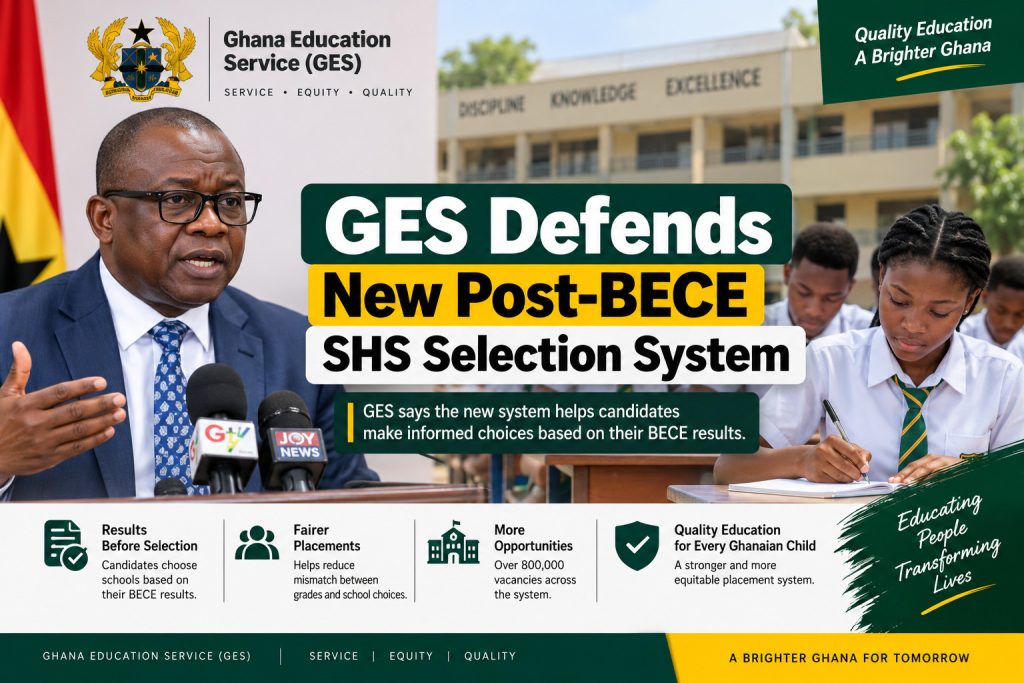
The Ghana Education Service (GES) has defended the new Senior High School selection system introduced for the 2026 placement exercise, saying the revised process has not caused the country’s current school placement challenges.
The new system allowed candidates who sat for the 2026 Basic Education Certificate Examination (BECE) to receive their examination results before selecting their preferred Senior High Schools (SHSs).
This was different from the previous arrangement, where candidates generally selected their preferred schools before sitting the BECE.
According to the GES, the change was introduced to help candidates make school choices based on their actual examination performance and reduce situations where students with less competitive grades selected highly demanded schools and later failed to secure placement.
However, the revised system has attracted questions from some parents and stakeholders following the release of the 2026/2027 SHS placement results.
Why GES Introduced the New Selection System
Under the revised process, BECE candidates received their results before making their SHS choices.
The idea was to give students more information about their academic performance before deciding which schools to select.
The Ghana Education Service explained that the change was intended to reduce the mismatch between candidates’ grades and the schools they selected.
For example, a candidate with a less competitive result could previously select a highly subscribed Category A school before knowing their final BECE performance. If the school received thousands of applications, many candidates could eventually miss out on placement.
With the revised system, candidates could consider their results when making their choices.
GES says the approach was therefore designed to make the selection process more informed and improve the relationship between candidates’ grades, school choices and available vacancies.
GES Says the Main Challenge Is Demand for Category A Schools
The GES has rejected the suggestion that the new selection system is responsible for the placement difficulties experienced by some candidates.
According to GES Public Relations Officer Daniel Fenyi, the major challenge is not a lack of space across Ghana’s second-cycle education system.
Instead, he said the major pressure is the very high demand for Category A schools.
More than 300,000 candidates reportedly sought admission to about 94 Category A schools, while those schools had approximately 76,000 declared vacancies.
This means the number of candidates seeking places in those schools was significantly higher than the number of available spaces.
The situation has resulted in many candidates having to consider alternative schools through the self-placement process.
More Than 800,000 Vacancies Were Declared
The GES says Ghana’s second-cycle institutions have enough overall capacity to accommodate qualified candidates.
According to the figures released during the 2026 CSSPS exercise, more than 800,000 vacancies were declared across the secondary and technical education system.
At the time of the Ministry of Education’s placement update, 527,932 out of 604,567 qualified candidates had secured placement, representing approximately 87.3 percent.
The figures included placements into Senior High Schools, Senior High Technical Schools and technical and vocational institutions.
The Ministry explained that the large number of available spaces does not necessarily mean every candidate can receive their preferred school.
This is because vacancies are distributed across different schools and categories, while demand is concentrated heavily in certain institutions.
Category A Schools Face the Highest Pressure
The 2026 placement figures demonstrate the difference between overall vacancies and demand for specific schools.
A total of 313,283 candidates selected Category A schools as their first choice, while only 76,417 vacancies were declared in that category.
Category B schools had 250,366 declared vacancies, while Category C schools had 468,652 vacancies.
These figures help explain why some candidates have struggled to obtain their preferred schools even though there are vacancies elsewhere in the education system.
The GES has therefore encouraged candidates who were not automatically placed to consider Category B and Category C schools when using the self-placement system.
Parents Raise Concerns Over Placements
While GES has defended the revised system, some parents have expressed concerns about the actual placement results.
Following the release of the 2026/2027 placement results, parents visiting placement resolution centres reported problems involving school assignments, programmes of study and residential status.
Some parents said their children had been assigned to schools they had not expected, while others sought changes from day status to boarding or requested schools closer to their communities.
At the GNAT Hall in Accra, parents also reported long queues and delays while waiting for their concerns to be addressed.
Similar concerns were reported in other locations.
The reports show that while the overall placement system has provided opportunities for thousands of candidates, individual placement cases can still require clarification or administrative intervention.
GES Says the System Has Improved
The defence of the revised selection system has also been supported by officials involved in the placement process.
Rev. Michael Commey, the Accra Regional Coordinator for Free SHS, said the CSSPS had improved significantly since its introduction in 2017.
He acknowledged that some placement anomalies still occur and may require correction.
Examples raised at resolution centres included students being assigned to schools far from their communities or receiving day status at schools where daily travel would be difficult.
Officials have been assisting affected candidates with such cases at the resolution centres.
This means that the existence of placement complaints does not necessarily mean that every aspect of the CSSPS has failed. Some cases may arise from individual placement data, school capacity, residential status or other factors that need to be checked.
Every Qualified Candidate Is Expected to Have an Opportunity
The GES has maintained that every qualified Ghanaian child should have the opportunity to progress to Senior High School or technical education.
The Service has therefore encouraged parents and candidates not to focus only on the most highly demanded schools.
Candidates who were not automatically matched with their choices can use the self-placement system to select from schools and programmes where vacancies remain.
The Ministry has also encouraged candidates to consider public SHSs, Senior High Technical Schools, technical and vocational institutions and participating private schools.
Candidates With Grade 9 in English or Mathematics
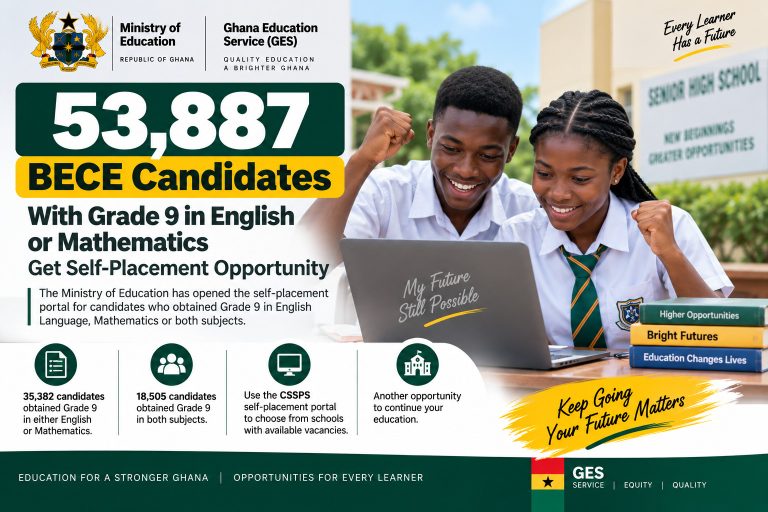
The government has also opened the self-placement system to certain BECE candidates who obtained Grade 9 in English Language or Mathematics.
According to the Ministry of Education, 35,382 candidates obtained Grade 9 in either English Language or Mathematics, while 18,505 candidates obtained Grade 9 in both subjects.
These candidates have been allowed to use the self-placement portal to select institutions and programmes where vacancies are available.
The arrangement is intended to provide an alternative pathway for candidates who were not automatically placed based on their examination results.
The Placement System Has Also Been Upgraded
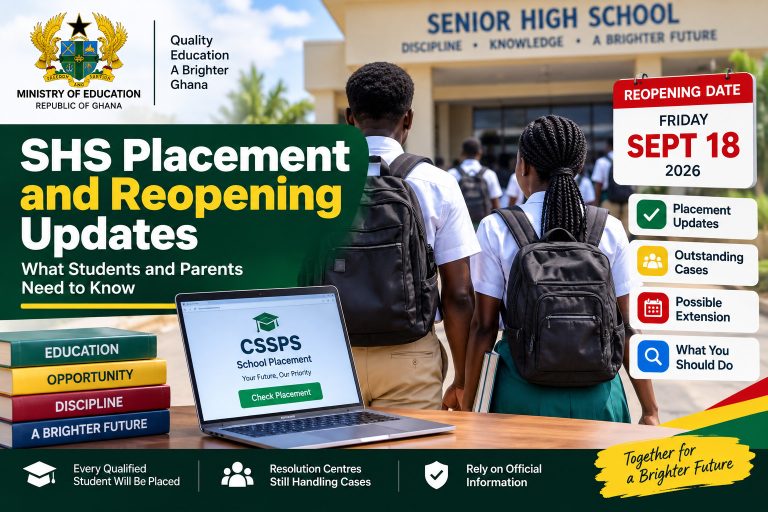
The 2026 CSSPS exercise includes an upgraded admission and enrolment feature.
The Ministry of Education announced that parents and guardians can complete some admission and enrolment processes online and download admission forms without necessarily travelling to individual schools.
The upgrade is intended to reduce the financial and logistical burden associated with school admissions.
School heads have also been directed not to admit or enrol students outside the official CSSPS process.
Parents and candidates are therefore encouraged to use official placement channels when dealing with admission and placement matters.
Placement Remains Free
Another important issue for parents is the cost of placement.
The Ministry of Education has stressed that CSSPS placement is free.
Parents and candidates should therefore be cautious about individuals who demand money in exchange for securing a placement or changing an existing placement.
The Ministry has also announced plans for a broader review of the CSSPS after the current placement exercise, following calls for greater transparency and accountability.
A Technical Working Committee is expected to examine the different components of the placement system and identify areas that require improvement.
What Parents and Candidates Should Know
The 2026 placement exercise shows that getting a place in SHS involves more than simply qualifying for secondary education.
Candidates must also compete for available spaces in the schools they select.
For highly demanded Category A schools, the number of applicants can be several times higher than the number of available places.
Parents should therefore encourage candidates to consider a broader range of schools and programmes when using self-placement.
Candidates who have already secured placement should also carefully check their school, programme and residential status and follow the admission instructions provided.
Those who believe there is a genuine discrepancy should use the official resolution channels rather than relying on unofficial intermediaries.
Looking Ahead
The new post-BECE selection system is now part of a broader conversation about how Ghana manages school selection and placement.
GES maintains that allowing candidates to select schools after receiving their BECE results was intended to make choices more informed and reduce mismatches between academic performance and school demand.
At the same time, concerns raised by parents over individual placement cases show that there are still areas that require attention.
The planned review of the CSSPS after the current placement exercise could provide an opportunity to examine these concerns and identify ways to make the process more transparent, efficient and responsive.
For now, candidates who have not secured their preferred schools are encouraged to use the official self-placement system and consider institutions with available vacancies.
The central message from GES remains that there is space within the wider second-cycle education system, even though demand for some individual schools is much higher than their available capacity.
As Ghana continues to expand access to secondary education, the effectiveness of the placement system will remain an important issue for students, parents, schools and education authorities.