
More Students Enrol in STEM at Sunyani Ridge Cluster of Schools
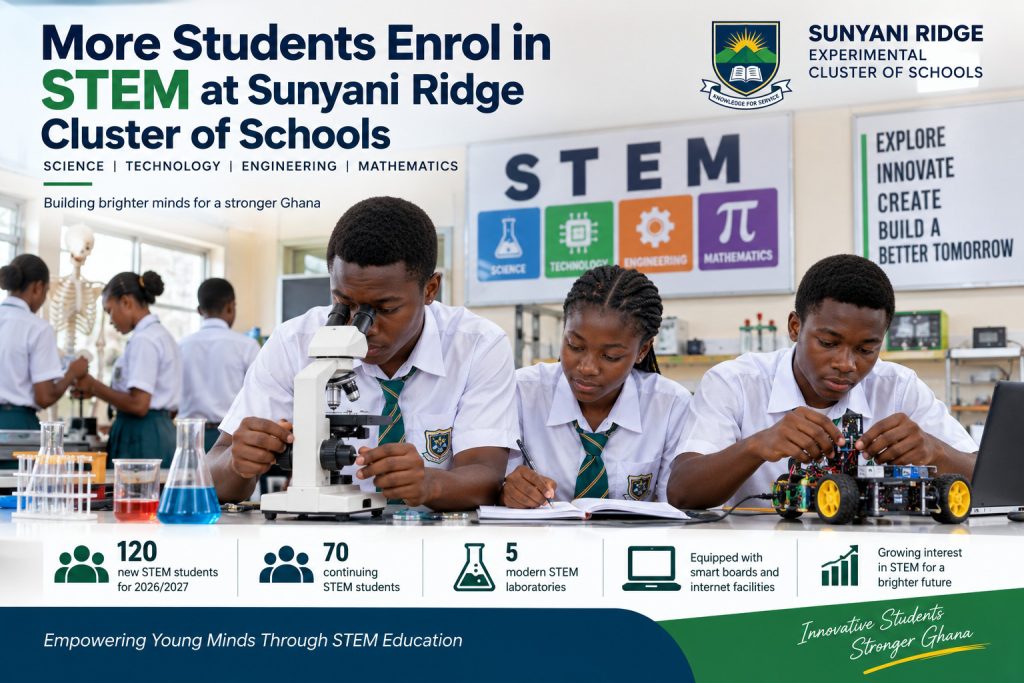
The number of students studying Science, Technology, Engineering and Mathematics (STEM) at the Sunyani Ridge Experimental Cluster of Schools has increased as the school begins the 2026/2027 academic year.
The school admitted 120 new students to its STEM programme for the new academic year, adding to the 70 continuing students already enrolled in STEM. The development highlights growing interest in STEM education among students at the school. https://ladaup.com/ges-calls-for-greater-investment-in-stem-education/
According to Mr Oliver Adu, Chairman of the Operational Committee for STEM at the school, the programme has officially commenced for the 2026/2027 academic year.
Five Modern STEM Laboratories
The Sunyani Ridge Experimental Cluster of Schools has five modern STEM laboratories designed to support practical learning.
The laboratories are equipped with smart learning boards and internet facilities to help students study subjects including Physics, Chemistry, Biology, Information and Communication Technology (ICT), and Robotics.
These facilities are expected to give students opportunities to combine classroom lessons with practical activities.
Practical learning is particularly important in STEM education because it allows students to understand scientific and technological concepts through activities, experiments and problem-solving.
120 New Students Join the Programme
The admission of 120 new students brings renewed attention to STEM education at the school.
Mr Adu said the school currently has 70 continuing STEM students, meaning the programme has a combined enrolment of 190 students for the 2026/2027 academic year.
The increase in enrolment comes at a time when STEM education continues to receive attention across Ghana, with schools and education stakeholders encouraging young people to develop skills in science, technology, engineering and mathematics.
For students, exposure to these areas can provide a foundation for further studies and careers in fields such as engineering, technology, science, computing and other technical disciplines.
Technology Supporting Classroom Learning
The availability of smart learning boards and internet facilities is another important part of the school’s STEM programme.
Modern technology can support teachers in presenting lessons and give students access to additional learning materials. In subjects that require practical demonstrations and visual explanations, digital resources can also make lessons more interactive.
The inclusion of Robotics and ICT alongside traditional science subjects also gives students exposure to technology-based learning.
As Ghana continues to place emphasis on science and technology education, facilities such as these can help schools provide students with opportunities to develop practical skills.
School Calls for More Support
Despite the progress made with the STEM programme, the school still faces some challenges.
Mr Adu raised concerns about the condition of office furniture and appealed to the government and other stakeholders to support the school with new furniture.
He also said the school requires frequent and stable electricity to support effective teaching and learning in the STEM programme.
Reliable electricity is particularly important for a programme that depends on laboratory equipment, computers, internet facilities and other technology.
The school also needs additional non-teaching staff, including security personnel, cleaners and labourers, according to Mr Adu.
Why STEM Education Matters
STEM education has become an important part of discussions about the future of education in Ghana.
Science and technology are increasingly connected to many areas of everyday life and the economy. Giving students opportunities to study STEM subjects can help them develop skills in critical thinking, problem-solving, creativity and innovation.
Schools also need appropriate facilities and trained teachers to make STEM learning effective.
The experience at Sunyani Ridge shows both sides of the issue. While student interest is growing, schools also require adequate infrastructure, electricity, equipment and support staff to sustain STEM programmes.
The five laboratories at the school provide a foundation for practical STEM education, but continued investment will be important as enrolment grows.
Growing Interest in STEM
The admission of 120 new STEM students at Sunyani Ridge Experimental Cluster of Schools reflects the growing participation of students in STEM programmes.
With 190 students now involved in the programme, the school will need to ensure that its facilities and resources can support the growing number of learners.
For the students, the programme offers an opportunity to develop knowledge and practical skills that can support their future education.
As the 2026/2027 academic year progresses, attention will also remain on whether schools have the resources needed to provide effective STEM education.
The development at Sunyani Ridge therefore highlights the importance of matching growing student interest with investment in laboratories, technology, electricity, furniture and other essential school resources.