New Aquaculture Scholarship Opens Opportunities for Ghanaian Students
A new scholarship programme is giving Ghanaian university students interested in aquaculture an opportunity to pursue their studies with less financial pressure.
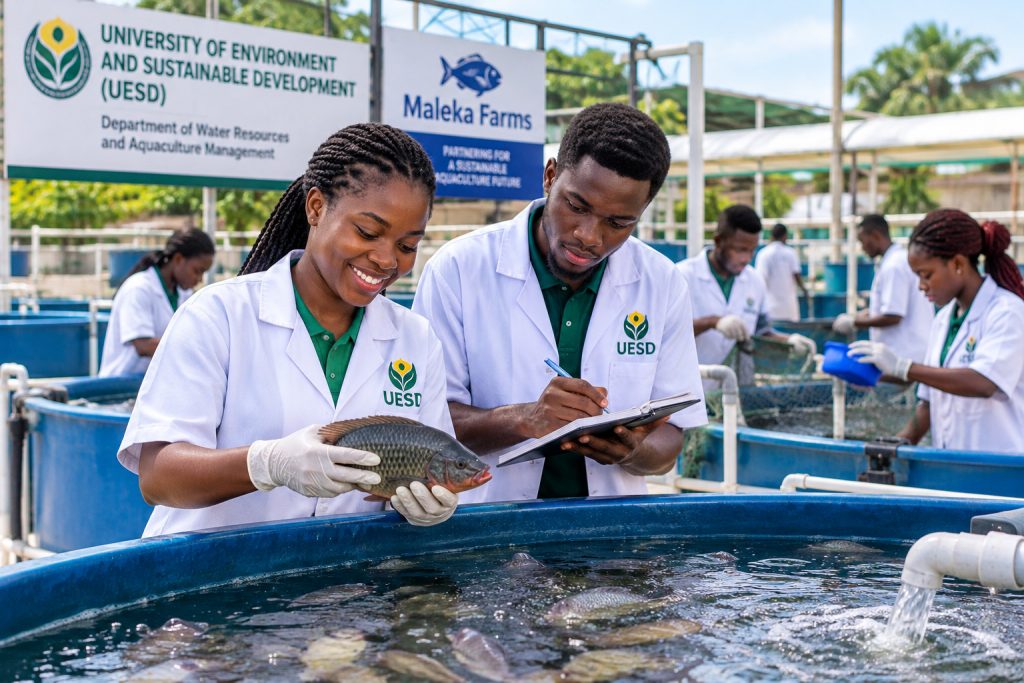
The University of Environment and Sustainable Development (UESD) in Somanya, Eastern Region, has partnered with Maleka Farms Limited to establish the Maleka Excellence Scholarship for Aquaculture Students, known as MESAS.
The scholarship is designed to support academically strong Ghanaian students who are facing financial difficulties while studying aquaculture. It will cover approved academic facility user fees for eligible students in Levels 100, 200 and 300 of UESD’s Department of Water Resources and Aquaculture Management.
The programme is scheduled to begin in the 2026/2027 academic year and is initially expected to operate for five years, subject to periodic review, available resources and continued agreement between UESD and Maleka Farms.
For students interested in fish farming, water resources, food production and agricultural technology, the new scholarship provides an opportunity to combine academic education with practical experience in Ghana’s aquaculture industry.
What Is the New Aquaculture Scholarship About?
The Maleka Excellence Scholarship for Aquaculture Students was created through a partnership between UESD’s Department of Water Resources and Aquaculture Management and Maleka Farms Limited.
The partnership was formalised through a Memorandum of Understanding signed at UESD in Somanya. The agreement brings together a university and an industry partner with a shared interest in developing skilled professionals for Ghana’s aquaculture sector.
The main purpose of MESAS is to reduce the financial difficulties that can prevent talented students from completing their education.
According to UESD, the scholarship is aimed at students who demonstrate strong academic performance while also experiencing financial need. Applicants will also be assessed on their character and genuine interest in aquaculture.
This means the scholarship is not simply intended to support students financially. It is also designed to encourage academic excellence and prepare students for professional opportunities in the aquaculture industry.
Who Can Apply for the Scholarship?
The scholarship is specifically targeted at eligible Ghanaian students studying in the Department of Water Resources and Aquaculture Management at UESD.
Students in Levels 100, 200 and 300 are eligible to be considered under the programme. Applicants will need to demonstrate academic performance, financial need, good character and a genuine interest in aquaculture.
The scholarship therefore provides an opportunity for students who are already pursuing aquaculture-related studies rather than being a general scholarship open to students in every programme at UESD.
Students interested in the opportunity should pay attention to official announcements from UESD for information about the application process, deadlines and documents required.
What Does the Scholarship Cover?
One of the major benefits of the MESAS programme is financial assistance with approved academic facility user fees.
For students facing financial challenges, academic fees can become an obstacle to continuing their education. The scholarship is intended to reduce that burden and allow successful beneficiaries to focus more on their studies.
UESD has clarified that the scholarship covers approved academic facility user fees for eligible beneficiaries. Students should therefore check the official scholarship terms to understand exactly what expenses are covered and which costs remain their responsibility.
Understanding the coverage is important because students should not assume that every expense associated with university life will automatically be paid by the scholarship.
Students Will Also Gain Practical Experience
The new aquaculture scholarship goes beyond financial assistance.
Successful beneficiaries will have opportunities for internships, practical training and mentorship at Maleka Farms Limited.
This practical component could be valuable for students because aquaculture is a field where classroom knowledge can be strengthened through hands-on experience.
Students may gain exposure to activities connected to fish production and farm management while learning from people working in the industry.
Maleka Farms has also identified areas such as fish breeding, feed development, water quality management, disease prevention and sustainable fish production as potential areas for practical work, research and collaboration.
The combination of university education and industry experience can help students better understand how theories and scientific principles are applied in real production environments.
Why Aquaculture Matters to Ghana
Aquaculture has become an increasingly important part of discussions around food production, employment and sustainable development in Ghana.
Fish is an important source of animal protein, and aquaculture provides a way of producing fish through managed farming systems.
The sector can also create employment opportunities beyond simply raising fish.
The aquaculture value chain includes hatchery operations, fish farming, feed production, processing, storage, transportation, marketing and other services. Maleka Farms highlighted these areas as potential sources of entrepreneurship and employment.
This means students who study aquaculture can potentially pursue different career and business pathways after completing their education.
Aquaculture Can Create Opportunities for Young People
The scholarship comes at a time when Ghanaian institutions are increasingly highlighting agriculture and aquaculture as areas where young people can develop practical skills and businesses.
Earlier in 2026, UESD promoted aquaculture entrepreneurship as one of the areas that could provide opportunities for young people along the Volta corridor.
The university said its aquaculture initiatives were helping young people acquire practical skills that could allow them to establish sustainable businesses, with some trainees already operating aquaculture enterprises.
This broader focus helps explain why industry-university partnerships such as MESAS can be important.
Education can provide students with scientific and technical knowledge, while industry partnerships can give them exposure to practical work and the realities of running businesses.
Scholarship Connects Education With Industry
One of the notable features of the Maleka Excellence Scholarship is the direct relationship between the university and a private aquaculture company.
University education can sometimes be heavily focused on classroom learning and academic research. Industry partnerships can create additional opportunities for students to understand how their knowledge is applied outside the classroom.
UESD has described its ambition to establish itself as a centre of excellence for aquaculture studies and has encouraged students to take advantage of partnerships with industry.
The partnership with Maleka Farms provides a practical example of how universities and companies can work together to develop skills in a specialised sector.
Research Will Be Part of the Opportunity
The partnership is also expected to support research and innovation.
Maleka Farms has identified fish breeding, feed development, water quality management, disease prevention and sustainable fish production as areas where students and researchers can undertake practical work.
Research in these areas can be important for improving fish production while reducing challenges that affect aquaculture businesses.
For students, research opportunities can also help develop analytical, scientific and problem-solving skills.
These skills can become useful whether a graduate eventually works for an aquaculture company, a government institution, a research organisation or starts a business.
Scholarship Will Initially Run for Five Years
The MESAS programme is scheduled to begin during the 2026/2027 academic year.
According to UESD, the initial agreement provides for a five-year period, although the programme will be subject to periodic review and the availability of resources.
This means students should not assume that the exact terms will remain unchanged throughout the entire five-year period.
The university and Maleka Farms will assess the programme over time, including its impact and available resources.
How Students Will Be Selected
The selection process is expected to consider several factors.
UESD has stated that applicants will be assessed based on academic performance, financial need, good character and genuine interest in aquaculture.
Graphic Online reported that the selection process will involve a scholarship selection committee within the department, followed by review through the School of Sustainable Development’s scholarship committee and final approval by university management.
The report also stated that applications would consider academic performance, financial need, personal statements and recommendation letters, with final selection conducted in consultation with Maleka Farms.
Students interested in applying should therefore prepare their academic records and other supporting documents carefully when the official application process is announced.
Academic Performance Will Remain Important
Receiving the scholarship will not mean that students can stop paying attention to their academic work.
UESD’s Vice-Chancellor, Professor Eric Nyarko-Sampson, encouraged beneficiaries to take their studies seriously and maintain the academic standards required to retain the scholarship.
This makes academic performance an important part of the scholarship opportunity.
Students who receive financial support will be expected to demonstrate continued commitment to their education.
What Students Should Know Before Applying
Students should first confirm that they meet the eligibility requirements before applying.
Because MESAS is specifically connected to UESD’s Department of Water Resources and Aquaculture Management, students should not assume that the scholarship is available to every Ghanaian university student.
Applicants should also wait for official application instructions from UESD and carefully follow the stated process.
Students should avoid relying on unofficial social media posts for application requirements. If an announcement contains a deadline, list of required documents or application procedure, it is best to verify the information through UESD’s official channels.
The university’s official website provides updates about the scholarship programme and other institutional announcements.
The Opportunity Goes Beyond University Fees
For students, the most valuable part of the programme may extend beyond the financial support.
The opportunity to gain internship experience, practical training and mentorship can help students understand the aquaculture industry before graduation.
Students can potentially use such experience to develop professional networks, understand workplace expectations and identify areas they may want to specialise in after university.
Practical exposure can also help students identify entrepreneurial opportunities within the aquaculture value chain.
Aquaculture and Food Security
Aquaculture is also connected to Ghana’s wider food-security discussions.
In July 2026, UESD experts highlighted aquaculture as an area with potential to support food security and employment. The university’s Nkabom Collaborative has also been working on aquaculture technology, entrepreneurship and related skills development.
In June, UESD reported that its Nkabom Collaborative had trained 70 young people and agribusiness practitioners in fish processing technology, including fish processing, preservation, food safety, branding and entrepreneurship.
These initiatives show that aquaculture is being considered not only as an academic subject but also as part of broader efforts to develop practical skills and employment opportunities.
A Growing Area for Entrepreneurship
A student studying aquaculture does not necessarily have to follow a traditional employment route after graduation.
The industry contains several stages where entrepreneurs can participate.
Someone with appropriate knowledge and resources could explore areas such as fish farming, hatchery operations, fish processing, feed-related businesses, transportation, storage or marketing.
However, running an aquaculture business requires more than academic knowledge. It can involve capital, technical skills, market research, appropriate facilities and good management.
This is why practical training and mentorship can be useful components of an academic programme.
Why the UESD and Maleka Farms Partnership Matters
The MESAS scholarship illustrates how private companies can contribute to higher education while also developing future professionals for their industries.
For UESD, the partnership provides another opportunity to strengthen its aquaculture programme and industry connections.
For Maleka Farms, working with students and researchers can create opportunities to support research and innovation while helping develop future aquaculture professionals.
For students, the partnership creates financial, academic and practical opportunities.
The wider aquaculture industry can also benefit if graduates leave university with stronger technical knowledge and practical experience.
What Interested Students Should Do Next
Students who believe they qualify should monitor UESD’s official announcements for the application process.
They should also ensure that their academic records are up to date and be prepared to provide evidence of their financial circumstances if requested.
A strong application should accurately present the student’s academic performance and genuine interest in aquaculture.
Students should not pay anyone who claims they can guarantee selection. Scholarship selection should follow the official process established by the university and its partner.
A New Pathway for Aquaculture Students
The Maleka Excellence Scholarship for Aquaculture Students provides a new pathway for Ghanaian students pursuing studies in water resources and aquaculture management.
Beginning in the 2026/2027 academic year, the programme will support eligible students in Levels 100, 200 and 300 by covering approved academic facility user fees.
More importantly, beneficiaries will have opportunities for internships, practical training and mentorship through Maleka Farms.
The programme comes at a time when Ghana is paying greater attention to aquaculture, food production, youth employment, entrepreneurship and sustainable agriculture.
For students with a genuine interest in aquaculture, the scholarship could provide both financial support and valuable exposure to the industry.
The success of the initiative will ultimately depend on effective implementation, continued industry collaboration and the commitment of students to their academic and professional development.
For now, students interested in the opportunity should follow UESD’s official announcements and carefully check the eligibility requirements and application instructions when the application window opens.