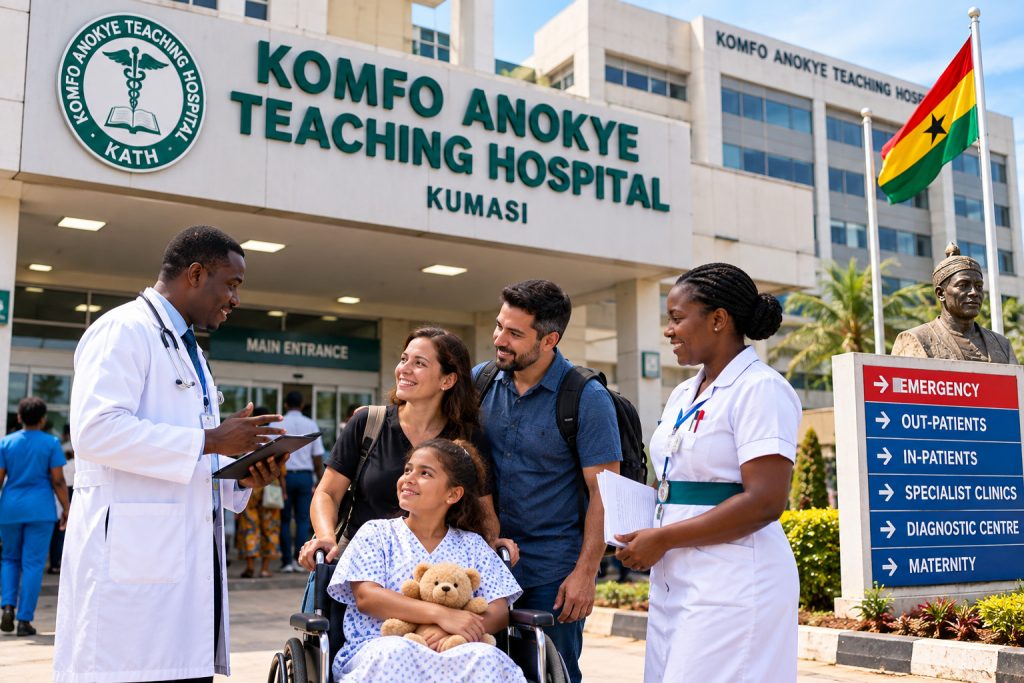
Why Komfo Anokye Teaching Hospital Is Attracting Patients From Other Countries
Meta Description: Komfo Anokye Teaching Hospital is receiving patients from Ghana and abroad, with specialist services and its Cleft Centre helping expand its reputation beyond Ghana.
Focus Keyword: Komfo Anokye Teaching Hospital
Excerpt: Komfo Anokye Teaching Hospital in Kumasi has become an important referral centre for Ghana and the wider West African region. Its specialist services, medical expertise and growing reputation are attracting some patients from outside Ghana.
Komfo Anokye Teaching Hospital in Kumasi has long been one of Ghana’s most important healthcare institutions. For decades, the hospital has served patients from Ashanti Region and other parts of the country, while also training doctors, nurses, pharmacists and other health professionals.
But its reach is now extending beyond Ghana’s borders.
In September 2026, the Chief Executive Officer of Komfo Anokye Teaching Hospital, Dr Paa Kwesi Baidoo, said the hospital receives patients from outside Ghana and highlighted the case of patients travelling from Mexico to the hospital’s Cleft Centre for surgery. He said the growing demand was one reason the hospital needed to continue expanding its facilities.
The development is significant because it shows that healthcare in Ghana is not only about serving local communities. Specialist hospitals can also become important destinations for patients from other countries when they have the expertise and services those patients need.
So, why are some patients travelling to Kumasi from outside Ghana to receive treatment at Komfo Anokye Teaching Hospital?
Komfo Anokye Teaching Hospital Has a Long History of Specialist Healthcare
One of the reasons behind KATH’s growing reputation is its long history.
The hospital was established in the 1950s and later became a teaching hospital following the establishment of the Kwame Nkrumah University of Science and Technology School of Medical Sciences in 1975.
Today, KATH describes itself as a major centre for specialist healthcare, medical education and research. The hospital has clinical directorates covering a wide range of medical services and serves as an important training centre for healthcare professionals.
This combination of treatment, teaching and research is important.
A teaching hospital is not simply a place where patients receive treatment. It is also a place where medical professionals are trained and where research and specialist knowledge can develop.
Over many years, this has helped KATH build a large pool of experienced healthcare professionals.
For patients looking for specialist treatment, the availability of trained professionals can be an important factor when deciding where to seek care.
KATH Serves Patients From Across Ghana
Before looking at international patients, it is important to understand the scale of KATH’s role within Ghana.
The hospital is located in Kumasi, one of the country’s major commercial and transport centres. Its location makes it accessible to large parts of Ghana.
KATH currently describes itself as a 1,200-bed hospital and says it receives direct referrals from 12 of Ghana’s 16 regions.
Its official profile also describes the hospital as providing specialist healthcare services to Ghana and the wider West African sub-region.
This means KATH is already operating as a regional referral centre rather than simply as a hospital for people living in Kumasi.
A patient in another part of Ghana may first visit a local hospital or regional facility. If the patient’s condition requires specialist treatment that is not available there, the patient may be referred to KATH.
That referral network has helped establish KATH as one of the major healthcare institutions in Ghana.
The Hospital Also Receives Patients From Outside Ghana
KATH’s international reach is not entirely new.
The hospital’s own profile has previously noted that it receives referrals from beyond Ghana’s borders, particularly from Côte d’Ivoire and Burkina Faso.
Recent reporting provides a newer example of this international reach.
In September 2026, KATH CEO Dr Paa Kwesi Baidoo said the hospital receives patients from other countries and specifically mentioned patients travelling from Mexico to the Cleft Centre for surgery.
The example is notable because Mexico is far beyond Ghana’s immediate West African neighbourhood.
It suggests that, at least for certain specialised procedures, the hospital’s reputation can reach patients and families much farther away.
However, it is important not to interpret one example as evidence that large numbers of international patients are travelling to Ghana for every type of treatment.
The available reporting confirms international patients but does not provide a comprehensive current breakdown of their numbers, countries of origin or medical conditions.
Specialist Services Can Make a Difference
One major reason patients may travel long distances for treatment is the availability of specialised services.
Not every hospital can provide every type of medical care.
Specialised procedures often require trained specialists, appropriate equipment, supporting medical teams and facilities designed for particular conditions.
KATH’s role as a tertiary hospital means that it provides forms of specialist care that may not be available at smaller hospitals.
The Cleft Centre is one example.
Cleft conditions can require specialised surgical and multidisciplinary care. A patient may need assessment, surgery and follow-up involving different healthcare professionals.
KATH has developed specialist capacity in this area, and the hospital’s leadership has cited international patients travelling to the centre as an example of the institution’s growing reach.
For a family seeking treatment for a complex condition, the availability of an experienced specialist team can be more important than the distance they have to travel.
KATH Has Built Medical Expertise Through Training
Another factor behind the hospital’s reputation is its connection with medical education.
KATH works closely with KNUST’s medical training system and serves as a major centre for undergraduate and postgraduate health-professional training.
The hospital says it is a major centre for the training of postgraduate medical and dental practitioners as well as professionals in pharmacy, nursing and other allied health fields.
This creates an environment where experienced professionals and trainees work within a large healthcare system.
For patients, the benefit can include access to teams with experience handling a wide variety of medical conditions.
For Ghana as a whole, the training function is equally important because healthcare professionals trained at KATH go on to work in different parts of the country and beyond.
The hospital’s influence therefore extends beyond the patients who physically visit its facilities.
Its Location in Kumasi Is Also Important
Kumasi’s location plays a major role in KATH’s reach.
The city is located in the middle belt of Ghana and serves as an important commercial and transport hub.
KATH’s official website says the hospital’s geographical location, national road network and Kumasi’s commercial setting make it accessible to the rest of Ghana, particularly areas close to Ashanti Region.
For patients travelling from northern Ghana, the middle belt or neighbouring countries, Kumasi can be a practical location for accessing specialist care.
The hospital’s location also places it within reach of neighbouring West African countries.
Historically, KATH has reported receiving patients and referrals from Côte d’Ivoire and Burkina Faso.
This geographic advantage is therefore connected to both its national and regional role.
Ghana’s Position in West Africa Matters
Healthcare does not operate separately from geography.
Patients generally look for treatment options that are accessible, trustworthy and capable of dealing with their medical needs.
For people living in neighbouring West African countries, travelling to Ghana can sometimes be more practical than travelling much farther to another part of the world.
Ghana also has a long history of hosting universities, professional training institutions and major healthcare facilities.
KATH’s role within this system gives it an established position in the region.
The hospital has also stated that its vision is to become an internationally recognised medical centre of excellence in specialised healthcare, training and research.
The arrival of international patients can therefore be viewed as part of the hospital’s wider regional role.
Research Strengthens the Hospital’s Reputation
Medical treatment and research are closely connected.
Hospitals that participate in research can contribute to improvements in diagnosis, treatment and healthcare delivery.
KATH says several health-related research projects have been undertaken through its directorates and units, with research published in national and international peer-reviewed journals.
Research can help healthcare professionals stay connected to developments in medicine.
It can also strengthen the academic environment within a hospital.
For a teaching hospital, this matters because doctors and other healthcare professionals are not only treating patients. They are also involved in learning, teaching and improving medical practice.
Over time, this can contribute to the institution’s reputation.
Patients May Also Look for Experienced Medical Teams
When people need specialist treatment, the medical team matters.
A hospital may have modern buildings, but patients also need doctors, nurses, technicians and other professionals who know how to use the available resources effectively.
KATH has a large workforce supporting its clinical services.
Its official profile previously reported more than 5,000 staff members across medical, nursing, pharmacy, allied health, administrative and support roles.
The hospital has also emphasised patient-centred healthcare and professional conduct among its staff. In 2023, management said it was working to make patient care a core priority and encouraged newly posted nurses and midwives to provide respectful, timely, compassionate and professional care.
Patient experience is difficult to measure from one institution-wide claim, but the focus on professional and patient-centred care is an important part of the hospital’s stated approach.
KATH Has Continued to Add and Improve Services
KATH has not remained unchanged over the years.
The hospital has introduced and developed different services and infrastructure as demand has grown.
A parliamentary briefing in 2022 listed projects and equipment including a Paediatric Intensive Care Unit, National Cleft Care Centre, Assisted Reproduction Technology Centre, maternity and children’s facilities, a 128-slice CT scanner, oxygen plants and an endoscopic suite.
Some of these projects have been developed through partnerships and support from different organisations.
The Cleft Care Centre, for example, has been associated with collaboration involving Smile Train and the Ghana Cleft Foundation.
The development of specialised infrastructure gives hospitals greater capacity to handle complex cases.
It also means patients do not necessarily have to travel to another country simply because a particular specialist service is unavailable locally.
The Hospital Is Still Under Pressure
The growing number of patients also creates challenges.
KATH is not a small community hospital.
It serves a very large referral population and receives patients from many regions.
Its official profile has previously stated that the hospital’s official bed capacity was 982 but that it generally operated with up to about 1,200 beds because of increasing demand.
More recent KATH information describes the hospital as a 1,200-bed facility.
The difference between demand and available capacity is important.
A hospital can become internationally recognised while still struggling with overcrowding, equipment requirements, infrastructure limitations and staff pressures.
In fact, increased demand can make expansion even more urgent.
That is why the KATH CEO’s recent comments about expanding the hospital are significant.
According to the September 2026 report, Dr Baidoo said the hospital needed to expand its facilities so that every patient coming to the hospital could receive the needed attention.
International Recognition Can Bring More Pressure
International patients can contribute to a hospital’s reputation, but they can also increase demand.
If more people learn about a specialised service and decide to travel to Ghana for treatment, the hospital must have enough capacity to handle the additional workload.
That means expansion cannot simply focus on buildings.
Hospitals also need trained staff, medical equipment, laboratories, medicines, operating theatres, intensive care facilities and supporting services.
The development of healthcare infrastructure must therefore happen alongside the development of human resources.
KATH’s experience illustrates this challenge clearly.
The hospital serves patients from across Ghana while also receiving some patients from other countries.
Its role is therefore both national and regional.
Why the Cleft Centre Is Particularly Important
The recent example involving patients from Mexico highlights the potential of highly specialised healthcare.
A patient is unlikely to travel from another continent simply to receive ordinary healthcare that is easily available at home.
International travel for medical treatment is more likely to occur when the patient is looking for a particular service, specialist expertise or treatment option.
The Cleft Centre is therefore important because it represents a highly specialised area of healthcare.
Its international reach also demonstrates how a specialised service within a Ghanaian public teaching hospital can become known beyond the country’s borders.
The example should not be interpreted as proof that KATH is competing with major international medical centres across every specialty.
Rather, it shows that Ghana has areas of specialist healthcare that can attract patients from outside the country.
KATH’s Regional Role Is Bigger Than International Patients
It is easy to focus on foreign patients because the idea attracts attention.
However, the hospital’s most important role remains serving patients in Ghana.
KATH receives referrals from 12 of Ghana’s 16 regions, according to its current official profile.
This means that thousands of Ghanaian patients depend on the hospital for specialist services.
The hospital has also been described as the major tertiary referral centre for much of the northern sector of Ghana.
In 2026, reports concerning the hospital’s referral role again highlighted its importance to patients from northern Ghana and neighbouring countries including Côte d’Ivoire and Burkina Faso.
International patients are therefore one part of a much larger healthcare story.
Better Healthcare Can Strengthen Ghana’s Reputation
The fact that patients can travel to Ghana for specialist treatment has implications beyond KATH.
It demonstrates that Ghana has medical professionals and institutions capable of providing specialised care that is recognised outside the country.
If such services continue to improve, they could contribute to Ghana’s broader healthcare reputation.
However, building a strong healthcare reputation requires sustained investment.
Hospitals need modern equipment, reliable infrastructure, specialist training and adequate staffing.
They also need systems that make healthcare accessible and safe for patients.
International recognition should therefore be accompanied by efforts to strengthen the healthcare system for everyone.
Technology and Modern Equipment Matter
Modern healthcare increasingly depends on technology.
Diagnostic equipment can help doctors identify medical conditions. Surgical equipment can support complex procedures. Electronic medical records can improve the management of patient information.
KATH has invested in different forms of medical technology over the years.
A 2022 parliamentary briefing cited the acquisition of equipment including a 128-slice Siemens CT scanner, C-arms, oxygen plants and an endoscopic suite.
Such investments can improve the hospital’s ability to diagnose and manage complex cases.
However, equipment alone is not enough.
It must be properly maintained and operated by trained professionals.
This is why investment in technology and investment in people must happen together.
The Future Could Bring More International Patients
It is difficult to predict exactly how many international patients KATH will receive in the future.
However, the hospital’s leadership has clearly indicated that demand is increasing and that expansion is necessary.
The September 2026 report on KATH’s 70th anniversary activities highlighted the hospital’s international patients and its plans to expand facilities.
If specialist services continue to develop and the hospital maintains strong professional standards, its regional and international visibility could continue to grow.
But that growth will need to be managed carefully.
The priority should remain quality and safe patient care.
A hospital cannot build a strong international reputation if it cannot adequately support the patients already depending on it.
What This Means for Ghana’s Healthcare Sector
KATH’s experience provides a wider lesson for Ghana.
The country has an opportunity to strengthen its position as a provider of specialised healthcare within West Africa.
That opportunity depends on continued investment in hospitals, medical education, research, technology and healthcare professionals.
It also depends on making sure that improvements benefit ordinary Ghanaian patients.
International recognition should not mean that local patients receive less attention.
Instead, stronger specialist services can potentially benefit both local and international patients.
When a hospital develops expertise in a particular area, that expertise can support training, research and treatment for people from many communities.
Final Thoughts
Komfo Anokye Teaching Hospital’s growing international reach is a reflection of its role as a major specialist and teaching hospital in Ghana.
The hospital has historically received referrals from across Ghana and neighbouring countries such as Côte d’Ivoire and Burkina Faso.
More recently, KATH’s CEO has highlighted patients travelling from outside Ghana, including a reported case of patients coming from Mexico for surgery at the Cleft Centre.
Several factors help explain this reach. KATH has a long history, specialist services, trained healthcare professionals, a medical education and research role, and a strategic location in Kumasi.
At the same time, the hospital faces the challenge that comes with its success: high demand.
The hospital’s leadership says expansion is necessary to ensure that patients receive the attention they need.
For Ghana, the story of KATH is therefore bigger than international patients.
It is a story about what a strong teaching hospital can contribute to healthcare, medical education, research and regional development.
As Ghana continues to invest in healthcare, KATH’s experience shows why specialist services, modern equipment, professional training and adequate infrastructure all matter.
The growing number of patients coming from different parts of Ghana and, in some cases, from outside the country, demonstrates the importance of continuing to strengthen the institution.
If that investment continues, KATH can remain an important healthcare centre for Ghana while serving an increasingly regional role in West Africa.