
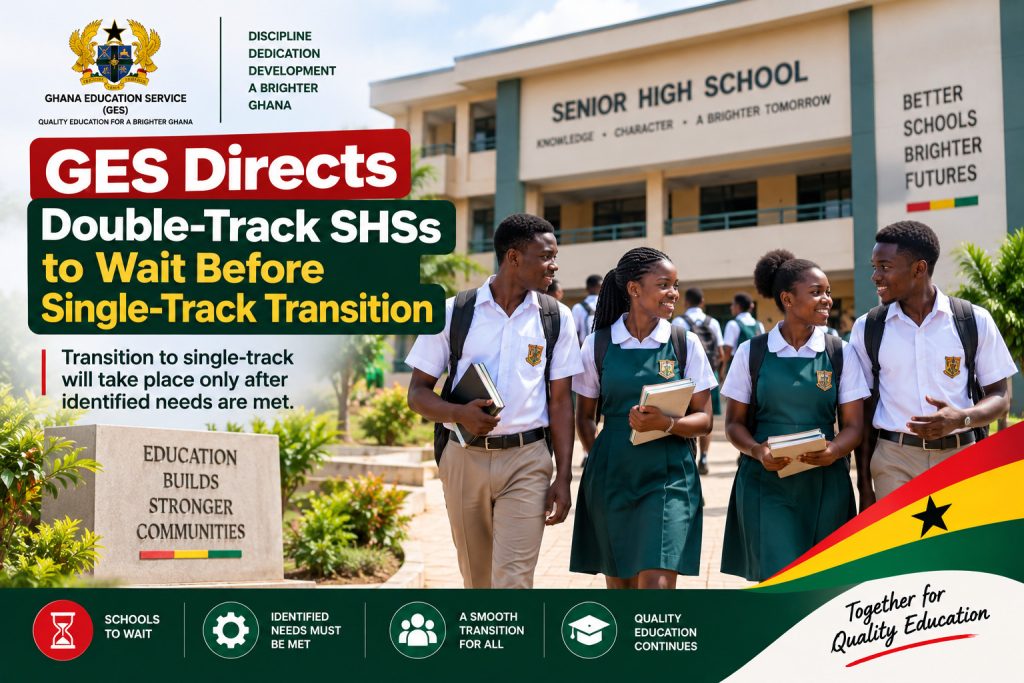
GES Directs Double-Track SHSs to Wait Before Single-Track Transition
The Ghana Education Service (GES) has directed Senior High Schools operating under the double-track system to wait before transitioning fully to the single-track system until identified requirements are met.
The directive forms part of the ongoing process to move more Senior High Schools away from the double-track arrangement while ensuring that schools have the necessary conditions to operate effectively under a single-track structure.
The information was published by the Ashanti Regional Education Directorate on September 14, 2026, under a notice titled “Transition of Double-Track Senior High Schools Back to Single-Track.”
GES Says Schools Must Wait
According to the GES Ashanti publication, double-track Senior High Schools have been instructed to wait before making the transition to single-track until identified needs are met.
This means that the transition is being approached in stages rather than requiring every remaining double-track school to change its system at the same time.
Schools affected by the directive will therefore continue following the arrangements applicable to them until the necessary requirements for the transition have been addressed.
Why the Transition Requires Preparation
Moving from a double-track arrangement to a single-track system requires schools to have enough capacity to accommodate students under the new structure.
Issues such as classroom space, accommodation, furniture and other school facilities can affect whether a school is ready to operate fully under a single-track arrangement.
The latest GES directive indicates that identified needs must be addressed before affected schools make the transition.
Ghana’s Gradual Move Away From Double-Track
The latest directive comes against the background of Ghana’s ongoing effort to phase out the double-track system in Senior High Schools.
The government previously announced its intention to completely abolish the double-track system through the Ghana Secondary Learning Improvement Project (GSLIP). The Information Services Department reported in January 2026 that the government was targeting the end of 2026 for the complete abolition of double-track.
The transition is therefore being implemented progressively as schools gain the capacity required for single-track operations.
Some Schools Have Already Returned to Single-Track
The move back to single-track has already been taking place in parts of the country.
In September 2025, GES announced that 99 double-track Senior High Schools had been taken off the double-track system and restored to traditional single-track operations.
In the Ashanti Region, a July 2026 report also indicated that 59 Senior High Schools had transitioned fully to single-track, while other schools remained under a transition arrangement.
The latest September directive shows that the transition process is continuing, but not every school is at the same stage.
What This Means for Students
For students attending schools that remain under the double-track or transitional arrangement, the latest directive does not announce an immediate change to their school arrangements.
Students and parents should therefore follow information provided by their respective schools and Regional or District Education Directorates.
Any change in a school’s track arrangement should be communicated through the appropriate education authorities.
What Schools Need Before the Transition
GES has not published a complete list of the specific “identified needs” in the short notice available from the Ashanti Regional Directorate.
However, the broader transition from double-track to single-track depends on schools having sufficient capacity and facilities to accommodate their students.
Schools that still have outstanding requirements will therefore need to address those needs before making the full transition.
The 2026/2027 Academic Year
The development comes as Senior High Schools prepare for the 2026/2027 academic year.
GES has set September 18, 2026 as the reopening date for Senior High Schools and Senior High Technical Schools under the approved academic calendar.
The existence of both single-track and transitional arrangements means parents and students should pay attention to the specific calendar and instructions applicable to their school.
What Parents Should Know
Parents should not assume that every school previously operating under double-track has automatically become single-track.
The latest GES directive specifically indicates that affected schools should wait until the identified needs are met.
Parents should therefore obtain information about their child’s school directly from the school or the appropriate GES education office rather than relying on unofficial claims about a change in track.
What Happens Next?
The transition process is expected to continue as schools meet the requirements needed for single-track operation.
Schools that have the necessary capacity can move forward with the transition, while those with outstanding requirements will wait.
This approach allows the education authorities to address capacity and infrastructure needs before schools make the change.
Conclusion
The Ghana Education Service has directed double-track Senior High Schools to wait before transitioning to single-track until identified needs are met.
The directive, published by the Ashanti Regional Education Directorate on September 14, 2026, shows that Ghana’s move away from the double-track system is continuing gradually rather than happening simultaneously in every school.
While a number of schools have already returned to single-track operations, others remain under transitional arrangements.
For students and parents, the key point is to follow official communication from their school and the Ghana Education Service regarding any change to their school’s track arrangement.