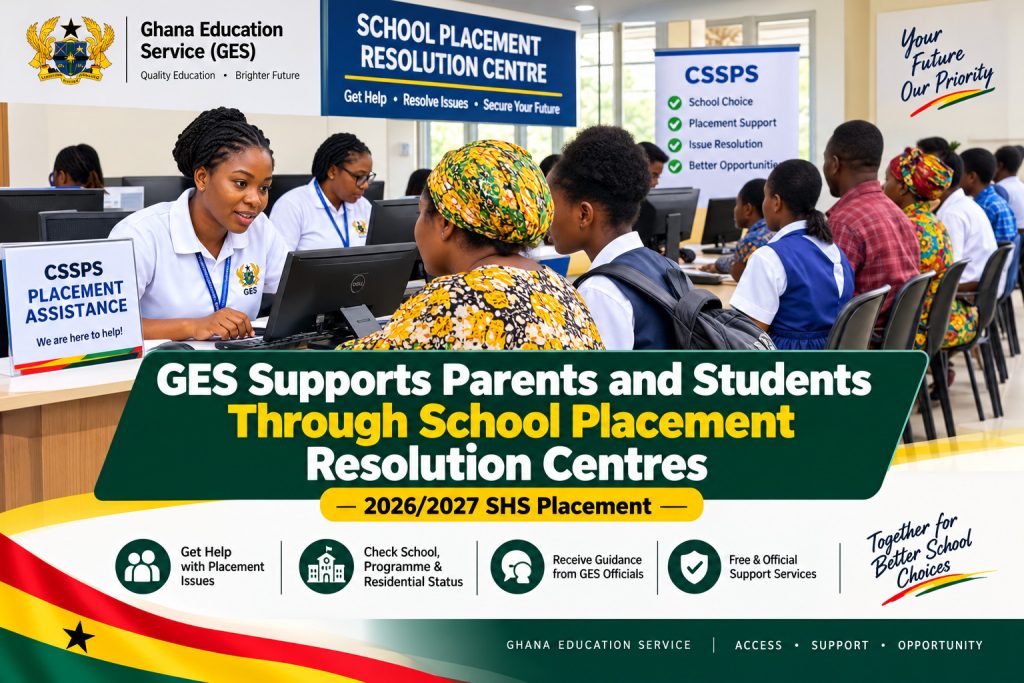
GES Supports Parents and Students Through School Placement Resolution Centres
The Ghana Education Service (GES) is supporting parents and students who are facing challenges with the 2026/2027 Senior High School (SHS) placement exercise through regional and national placement resolution centres.
The centres have become important points of assistance following the release of the 2026/2027 Computerised School Selection and Placement System (CSSPS) results on September 4, 2026.
Parents and students who have encountered problems involving school placements, programmes of study, residential status and other placement-related issues have been visiting the centres to seek clarification and assistance.
The Ministry of Education says the centres are part of efforts to address genuine placement concerns and help qualified students continue their education.
Why the Placement Resolution Centres Were Established
The CSSPS is designed to match qualified candidates with SHSs, Senior High Technical Schools, and technical and vocational institutions based on factors including examination results, selected programmes and available vacancies.
However, the 2026 placement exercise has generated concerns from some parents and students.
Reports from resolution centres indicate that some families have sought assistance because their children were placed in schools they did not expect, assigned different programmes, or given residential arrangements that created difficulties.
In some cases, parents have also raised concerns about the distance between their homes and the schools assigned to their children.
The resolution centres provide an official channel through which such concerns can be brought before placement officials.
National Resolution Centre in Accra
The GNAT Hall in Accra has been designated as the National Placement Resolution Centre.
The Ministry of Education says technical teams have been deployed to assist candidates and parents with genuine placement problems.
Parents and candidates are also encouraged to seek assistance from GES or Ghana TVET Service offices at the regional level before travelling to the national centre.
The arrangement is intended to reduce the cost and inconvenience involved in travelling long distances to seek help with placement issues.
Regional Centres Are Also Handling Cases
Placement assistance is not limited to Accra.
Regional education offices and resolution centres have been dealing with placement concerns from parents and students in different parts of the country.
In the Central Region, for example, the regional CSSP Resolution Centre had attended to more than 500 students facing placement challenges by September 12.
Officials reported cases involving requests to change schools or programmes, residential-status problems, distance concerns and errors in student data.
In Kumasi, parents and candidates have also visited the placement resolution centre at KTI Hall to seek assistance with pending and disputed placements as the September 18 reporting date approached.
What Kind of Problems Can Be Reported?
Placement officials have been dealing with several types of concerns.
Some parents have sought corrections where the school assigned to their child appeared different from the choices they expected.
Others have raised concerns about programmes of study, especially where the programme assigned does not correspond with the candidate’s preferred course.
Residential status has also been an issue, with some parents requesting clarification or changes between boarding and day arrangements.
Distance is another concern. Some candidates have been assigned to schools far from their communities, making daily transportation difficult where the student has been given day status.
These cases are considered individually by the officials handling placement concerns.
Parents Have Reported Long Queues
The increased demand for placement assistance has also created pressure at some resolution centres.
At the GNAT Hall in Accra, parents and guardians reported long queues and delays while waiting for their cases to be addressed.
Some parents told the Ghana News Agency that they had spent several hours at the centre seeking assistance with placement discrepancies.
Parents also called for improved queue management and better arrangements for people waiting to have their concerns resolved.
The high turnout reflects the pressure surrounding the transition of thousands of BECE candidates into second-cycle education.
GES Says There Is Space for Qualified Students
The placement concerns are occurring alongside an overall increase in demand for particular schools.
GES Public Relations Officer Daniel Fenyi explained that the main challenge was not necessarily a shortage of space across the country’s SHS system.
According to GES, more than 300,000 candidates sought admission to about 94 Category A schools, which had approximately 76,000 declared vacancies.
The Service has therefore encouraged candidates who were not automatically placed in their preferred schools to consider Category B and Category C schools through the self-placement process.
The Ministry’s wider placement figures show that 527,932 candidates had secured placement out of 604,567 qualified candidates, representing about 87.3 percent at the time of the September 7 update.
Parents Should Use Official Channels
The Ministry of Education and GES have urged parents and candidates to use official placement channels when dealing with CSSPS problems.
This is important because the government has repeatedly warned against individuals who claim they can secure or change school placements in exchange for money.
The Ministry has stressed that CSSPS placement is free.
Parents who encounter genuine placement problems should therefore seek help from the designated resolution centres, GES regional offices or other official channels rather than relying on unofficial intermediaries.
Online Admission Has Also Been Introduced
The 2026 CSSPS exercise includes an upgraded admission portal that allows parents and guardians to complete some admission and enrolment processes remotely.
According to the Ministry, the feature allows parents to enrol students and download admission forms without necessarily travelling to individual schools.
The change is intended to reduce transportation expenses and some of the logistical difficulties associated with school admission.
School heads have also been directed not to admit or enrol students outside the official CSSPS process.
Students Should Keep Their Placement Information
Students and parents should keep copies of important placement information, including placement details and reference numbers.
When visiting a resolution centre, having the relevant information available can help officials verify the student’s records and understand the nature of the complaint.
Parents should also carefully check the school, programme and residential status assigned to their children.
Where something appears incorrect, they should raise the issue through the appropriate official channel as early as possible.
Parents Should Consider All Available Options
The placement process has shown that some schools receive far more applications than the number of spaces available.
For this reason, parents may need to consider a broader range of schools when using the self-placement system.
GES has encouraged candidates to consider Category B and Category C schools as well as Senior High Technical Schools and technical and vocational institutions where appropriate.
The Ministry has also announced that 85 private SHSs will participate in the Free SHS Programme for the 2026/2027 academic year, creating additional placement opportunities.
Placement Concerns Are Still Being Reviewed
The Ministry of Education has announced plans for a comprehensive review of the CSSPS after the current placement exercise.
A Technical Working Committee is expected to examine the various components of the system and identify areas that may require improvement.
The Ministry says the review will focus on strengthening transparency, accountability, efficiency and responsiveness in the placement process.
This means the current resolution process is dealing with immediate placement concerns while a broader review is expected to examine the system itself.
What Parents and Students Should Do
Parents and students who have placement concerns should first check the official CSSPS information available to them.
If a genuine problem remains, they should use the appropriate GES or Ghana TVET Service regional office or designated resolution centre.
They should carry the necessary placement information and clearly explain the issue they want officials to investigate.
Parents should also avoid paying anyone who promises to influence the placement process.
The Ministry has made it clear that official CSSPS placement is free, and reported demands for payment connected to placement can be investigated.
Final Thoughts
The school placement resolution centres are playing an important role in helping parents and students deal with challenges arising from the 2026/2027 CSSPS exercise.
From school and programme concerns to residential status, distance and data issues, officials are working through cases brought forward by affected families.
The Ministry of Education has assured parents and students that outstanding placement concerns will continue to receive attention, with Education Minister Haruna Iddrisu visiting the National Resolution Centre on September 16 to assess the challenges and review efforts to resolve them.
As the September 18 reopening date approaches, parents and candidates with genuine concerns should use the official channels available to them and avoid unofficial intermediaries.
The ongoing placement exercise also highlights the importance of accurate student information, realistic school choices and effective communication between candidates, parents, schools and education authorities.
For the latest updates on GES, CSSPS, BECE, SHS placement, JHS and education news in Ghana, keep following Ladau.