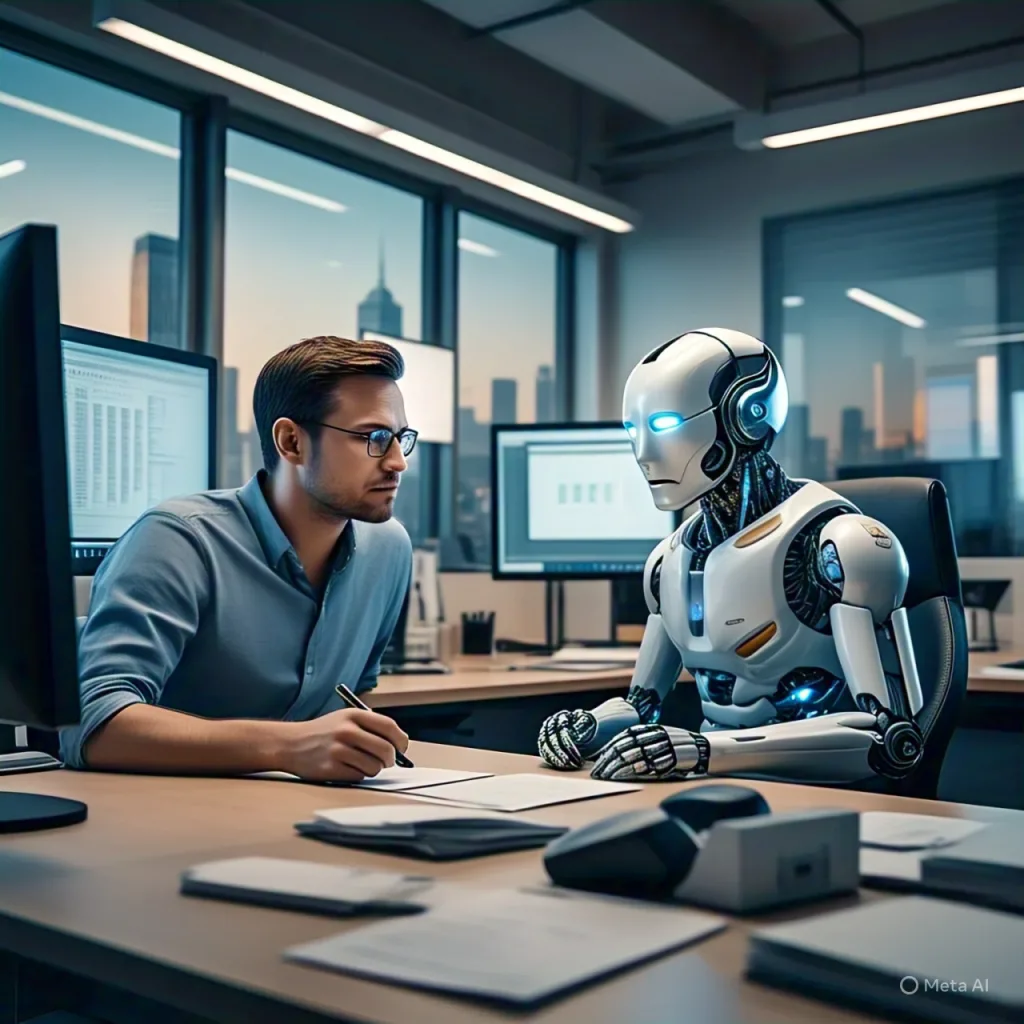
If you’ve been watching the news, scrolling LinkedIn, or just listening to conversations around you, one thing is clear: AI is everywhere.
From chatbots handling customer service to tools writing articles and generating artwork, artificial intelligence is transforming industries fast. And it’s sparked one of the biggest questions of our time:
Can AI replace your job? Or help you do it better?
The fear is real. But so is the opportunity.
In this article, we’re going deep — no fluff. You’ll get real answers about what AI can and can’t do, which jobs are most at risk, and how you can actually leverage AI to stand out, not fade out.
Let’s break it down.
What AI Is Really Good At (and What It’s Not)
Before we jump into whether AI will replace your job, it’s important to understand what AI actually does well — and where it falls short.
AI thrives in tasks that are:
-
Repetitive
-
Rule-based
-
Data-heavy
-
Pattern-driven
So things like:
-
Data entry
-
Scheduling
-
Basic customer support
-
Inventory tracking
-
Automated reports
These are often the first to be automated. Why? Because AI does them faster, without fatigue, and often more accurately.
But here’s what AI struggles with:
-
Emotional intelligence
-
Creative originality
-
Ethical judgment
-
Strategy and vision
-
Human connection
AI doesn’t think like you. It doesn’t care like you. It doesn’t lead like you.
So while it may replace tasks, it rarely replaces roles entirely. That’s the key.
Jobs Most at Risk of AI Replacement
Let’s not sugarcoat it — some jobs are more vulnerable than others. But again, it’s mostly the repetitive parts of those jobs that are threatened.
Industries at high risk:
-
Data processing & admin
-
Basic accounting
-
Retail checkout
-
Telemarketing
-
Entry-level coding
Think: anything that follows a script or rulebook.
Examples:
-
A virtual assistant may get replaced by an AI scheduling tool.
-
A junior copywriter might lose assignments to ChatGPT-style generators.
-
A stockroom worker could be swapped for warehouse robotics.
But even in these fields, people who upskill and adapt can stay ahead.
Jobs AI Won’t Replace (But Will Reinvent)
Now let’s talk hope — because it’s not all bad news. Some jobs will never disappear. They’ll just evolve.
Here’s where AI can’t compete:
-
Leadership & management: Inspiring people, making tough calls, building vision.
-
Human care roles: Therapists, social workers, nurses — AI can assist but not feel empathy.
-
Creative professions: Writers, designers, musicians — AI can draft, but it lacks soul.
-
Skilled trades: Electricians, plumbers, chefs — real-world hands-on work is hard to automate.
In these roles, AI becomes more like a copilot than a competitor.
You stay in charge. AI just gives you superpowers.
Can AI Replace Your Job? Or Help You Do It Better?
Here’s the golden question — and the answer depends on how you respond to AI’s rise.
Let’s explore two real possibilities.
Path 1: You ignore AI
You stick to the old way. You avoid learning new tools. You tell yourself AI won’t touch your field.
What happens? You fall behind. Others do your job faster, cheaper, and better — with AI as backup.
Path 2: You embrace AI as your partner
You learn how to use tools like ChatGPT, Canva AI, Notion AI, or AI design assistants.
You use AI to brainstorm faster, automate the boring stuff, and amplify your strengths.
Suddenly, you’re more productive. You have more time for strategy. Your output skyrockets.
AI doesn’t replace you. It upgrades you.
How to Start Using AI in Your Work Today
Let’s make this practical. Here are some simple ways you can start using AI to do your job better — regardless of your field.
1. Content creation
Use tools like ChatGPT or Jasper to generate ideas, outlines, or rough drafts. You still polish and humanize them.
2. Email & communication
Apps like GrammarlyGO or Notion AI help write and proofread emails, proposals, and documents quickly.
3. Scheduling & planning
AI scheduling tools (like Reclaim or Motion) find the best time slots, balance your workload, and automate calendar changes.
4. Market research
Use AI to summarize industry trends, competitor analysis, or customer feedback at scale.
5. Brainstorming & ideation
Stuck on a project? Let AI generate 20 ideas in 30 seconds — you just pick and shape the best ones.
Real Talk: Is Your Job Safe from AI?
No one can guarantee job security anymore — not even CEOs. But here’s the new rule of career survival:
If AI can replace parts of your job, learn to do the parts AI can’t — and let AI handle the rest.
It’s not about competing with robots. It’s about collaborating with them.
Ask yourself:
-
What do I do that requires human judgment, empathy, or creativity?
-
What parts of my work are repetitive or low-value?
-
How can I train AI to take over the boring stuff, so I can focus on the genius stuff?
That’s how you win.
How Businesses Are Adapting to AI (and How You Should Too)
Smart companies aren’t laying everyone off and going full-AI. They’re rethinking roles.
-
Writers are becoming editors of AI-generated content
-
Marketers are becoming prompt engineers
-
Managers are becoming data interpreters with AI dashboards
This means the most valuable employees are the ones who know how to work with AI — not just fear it.
So here’s how you stay ahead:
-
Stay curious.
-
Keep learning.
-
Try new AI tools.
-
Upskill constantly.
-
Add “AI-assisted” skills to your resume.
The winners in this new era are the ones who don’t resist change — they ride it.
Final Thoughts: Human Skills Still Matter Most
Let’s end on something real.
AI is amazing — but it’s still a tool.
It can write, code, draw, and summarize. But it can’t:
-
Dream
-
Care
-
Inspire
-
Lead
-
Heal
-
Connect
Those are your superpowers. No AI can touch that.
So if you’re asking, “Can AI replace your job?” — here’s the truth:
Not if you evolve with it. Not if you build the right skills. And not if you remember what only you — a human — can bring to the table.
Use AI to go faster. Think deeper. Create better.
But never stop being the human that makes it all matter.