
The year may have started with many plans, dreams, and expectations. Maybe you told yourself that this would be the year you would get a better job, learn a new skill, improve your CV, start applying for opportunities, or finally take your career seriously. But life does not always move the way we plan.
Sometimes work becomes stressful. Sometimes money problems take attention. Sometimes fear, delay, disappointment, or lack of direction makes you push your career plans aside. Before you realize it, half of the year is almost gone, and you begin to wonder if there is still enough time to make progress.
The good news is this: the rest of the year is still enough time to do something meaningful.
You do not need to wait for a new year before you start again. You can set better career goals now, review where you are, and take practical steps that can move you forward before the year ends.
Career growth does not always happen through one big opportunity. Most of the time, it happens through small, intentional actions repeated over time. A better CV, a new skill, a good application letter, a strong interview performance, or even the courage to apply for a role can open a new door.
This article will help you understand how to set clear career goals for the rest of the year and create a simple plan you can actually follow.

What Are Career Goals?
Career goals are the things you want to achieve in your work life or professional journey. They give you direction and help you know what to focus on.
A career goal can be big or small. It can be something like getting a new job, improving your skills, gaining work experience, starting a professional course, building your personal brand, preparing for promotion, or becoming better at what you already do.
For some people, career goals may mean finding their first job. For others, it may mean changing careers, getting promoted, starting a side business, learning digital skills, or becoming more confident at work.
The most important thing is that your career goals should be clear, realistic, and connected to the kind of future you want.
Without career goals, it is easy to move through the year without direction. You may be busy every day, but not really growing. You may be working hard, but not building anything that improves your future. That is why setting career goals is important.
Why Career Goals Matter
Career goals help you stop moving randomly. They give your effort a purpose.
When you know what you want to achieve, it becomes easier to choose what to learn, where to apply, who to connect with, and how to spend your time. You also become more serious about your personal development because you can see what you are working toward.
For example, if your goal is to get a better job before the year ends, you will know that you need to update your CV, improve your application letter, check job platforms regularly, and prepare for interviews. If your goal is to get promoted, you may need to improve your attitude at work, learn leadership skills, communicate better, and take more responsibility.
Career goals also help you measure progress. Even if you do not achieve everything immediately, you can still see whether you are moving forward or staying in the same place.
Another reason career goals are important is that they build confidence. When you set a goal and take action, you begin to trust yourself more. You stop feeling helpless and start feeling responsible for your own growth.
Start by Reviewing Where You Are Now
Before you set new career goals, take time to review where you are right now.
Many people rush to set goals without first understanding their current situation. But if you do not know where you are, it becomes difficult to know what needs to change.
Ask yourself a few honest questions.
Are you happy with your current job or career path? Are you learning and growing where you are? Do you feel stuck? Are you applying for better opportunities? Do you have the skills needed for the kind of work you want? Is your CV updated? Are you confident in interviews? Are you using your free time to improve yourself?
These questions are not meant to make you feel bad. They are meant to help you see clearly.
Sometimes, the reason people do not grow is not because they are not capable. It is because they have not taken time to review their situation and create a better plan.
Look at the first part of the year and ask yourself what worked and what did not work. Maybe you applied for jobs but did not get responses. Maybe you wanted to learn a skill but kept postponing it. Maybe you stayed in a job that is no longer helping you grow. Maybe you started well but lost focus along the way.
Be honest, but do not be too hard on yourself. The goal is not to blame yourself. The goal is to learn and move forward.
Decide What You Want Before the Year Ends
After reviewing where you are, the next step is to decide what you want to achieve before the year ends.
This is where many people get confused because they want to do everything at once. They want a new job, a new skill, a business, more money, better confidence, and a better lifestyle all at the same time.
There is nothing wrong with wanting more, but when your goals are too many, your focus becomes weak.
Choose the most important career goals first.
Ask yourself: what one or two career achievements would make this year feel better for me?
Maybe you want to get your first job. Maybe you want to move from your current job to a better one. Maybe you want to learn a digital skill. Maybe you want to improve your communication skills. Maybe you want to prepare for a promotion. Maybe you want to start building an online presence around your work.
Your goal should be clear enough that you know when you have achieved it.
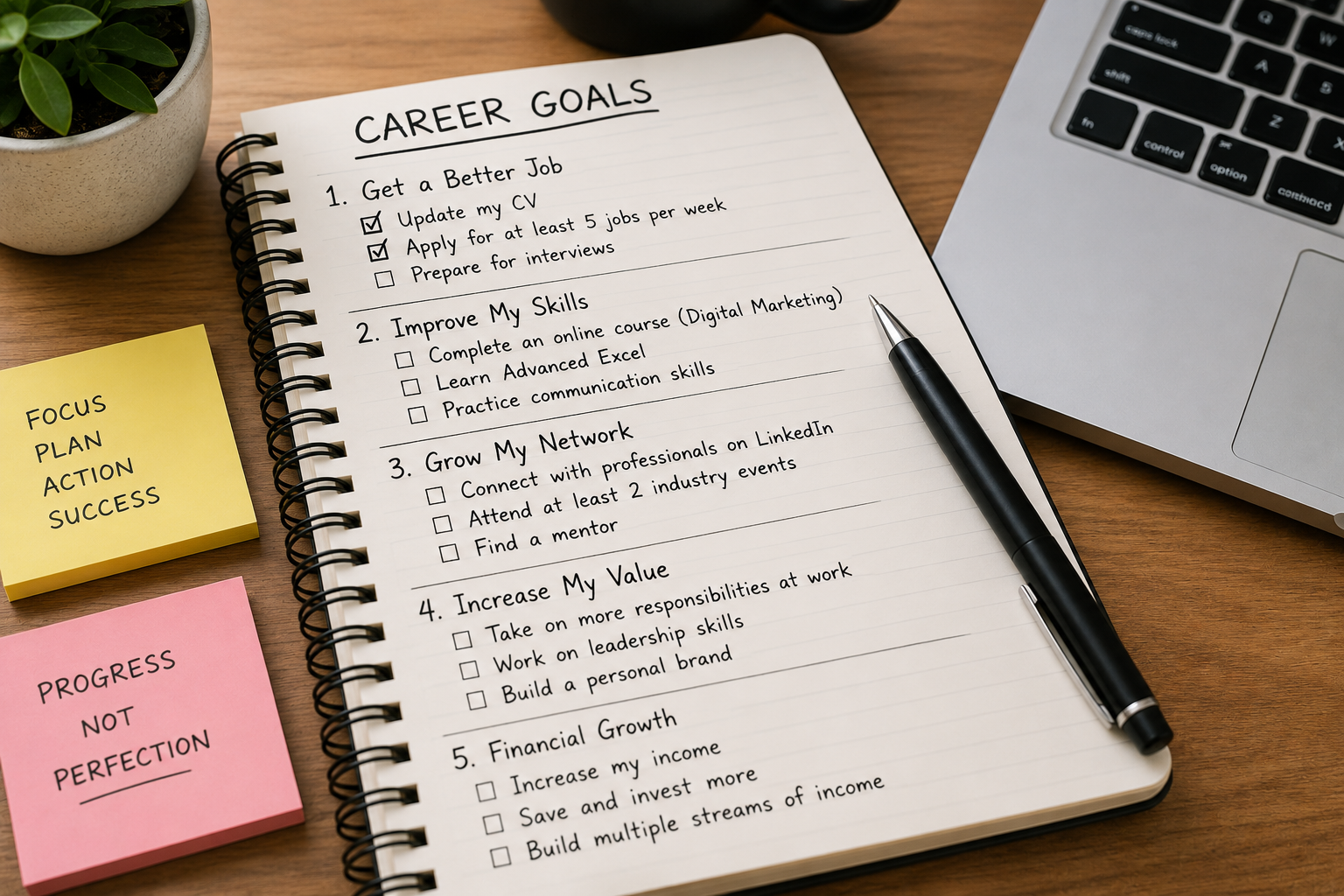
Instead of saying, “I want to grow in my career,” say, “I want to update my CV, apply for at least five jobs every week, and improve my interview skills before the end of the year.”
Instead of saying, “I want to learn something new,” say, “I want to complete a course in digital marketing, graphic design, data analysis, customer service, or project management before December.”
Clear goals are easier to follow than vague wishes.
Make Your Career Goals Realistic
It is good to dream big, but your goals must also be realistic.
A realistic goal does not mean a small goal. It simply means a goal you can work toward with the time, resources, and energy you have.
For example, if you are very busy with work, it may not be realistic to study five hours every day. But it may be realistic to study thirty minutes to one hour daily. If you are looking for a new job, it may not be realistic to expect instant results, but it is realistic to improve your CV, apply consistently, and prepare better for interviews.
Realistic career goals reduce pressure and help you stay consistent.
Many people quit because they set goals that are too heavy from the beginning. They become excited for a few days, then lose energy because the plan is not practical.
Start with what you can manage. Small progress is still progress.
If you can read one career article every day, do it. If you can apply for three jobs every week, start there. If you can take one online lesson every evening, stay consistent. If you can improve one part of your CV this week, that is a step forward.
The rest of the year may not be enough to change everything, but it is enough to begin a serious transformation.
Break Your Goals Into Monthly and Weekly Steps
A career goal becomes easier when you break it into smaller steps.
Let us say your goal is to get a better job before the year ends. That goal may feel big, but you can break it down.
In the first month, you can update your CV and application letter. In the second month, you can improve your LinkedIn profile or online presence. In the third month, you can start applying for jobs consistently. In the fourth month, you can practice interview questions. In the fifth and sixth months, you can continue applying, networking, and improving your skills.
When you break a big goal into small steps, it becomes less scary.
Weekly steps are also important. Every week, ask yourself what you can do to move closer to your career goals.
You could decide that this week, you will update your CV. Next week, you will apply for five jobs. Another week, you will learn how to answer interview questions. Another week, you will connect with someone in your field. Another week, you will complete a short online course.
These small steps may look simple, but they can create real results when you repeat them.
Improve the Skills That Can Move You Forward
One of the best career goals you can set for the rest of the year is to improve your skills.
Skills can open doors. Sometimes, the difference between where you are and where you want to be is not just opportunity. It may be preparation.
Look at the kind of job or career you want. What skills are employers looking for? What skills are people in that field using? What do you need to learn to become more valuable?
Some useful skills include communication, writing, public speaking, customer service, computer skills, leadership, problem-solving, teamwork, sales, digital marketing, graphic design, data analysis, project management, and social media management.
You do not need to learn everything at once. Choose one or two skills that match your career direction and focus on them.
If you are a job seeker, improving your CV writing and interview skills can help. If you are already working, improving communication and leadership can make you stand out. If you want to enter the digital space, learning a practical digital skill can help you create more opportunities.
The world is changing, and the people who keep learning are more likely to stay relevant.
Update Your CV and Professional Profile
If your career goal is connected to finding a job or getting better opportunities, your CV matters.
Many people lose opportunities not because they are not qualified, but because their CV does not present them well. A good CV should be clear, organized, and focused on what you can offer.
Take time to review your CV. Remove unnecessary information. Correct spelling mistakes. Add your recent experience, skills, achievements, training, and responsibilities. Make sure your contact details are correct.
Also, if you use LinkedIn or any professional platform, update your profile. Use a clear photo, write a good summary, add your skills, and show what you do.
Your CV and professional profile should not wait until you see a job vacancy. Prepare them early so that when an opportunity comes, you are ready.
Being ready is part of career growth.
Build Better Work Habits
Career goals are not only about getting a new job or learning a new skill. They are also about becoming the kind of person who can handle better opportunities.
Your work habits matter.
Do you arrive on time? Do you finish tasks properly? Do you communicate well? Do you keep learning? Do you take correction? Do you respect people? Do you solve problems or complain about everything? Do you show responsibility when nobody is watching?
These things may look small, but they can affect your career growth.
If you want to grow before the year ends, look at your daily work habits. Choose one habit to improve. Maybe you need to become more punctual. Maybe you need to stop procrastinating. Maybe you need to communicate better. Maybe you need to take your current role more seriously.
Sometimes, the next level of your career requires a better version of your attitude.
Track Your Progress Every Month
Setting career goals is not enough. You also need to track your progress.
At the end of every month, ask yourself what you have done toward your goals. Did you apply for the jobs you planned to apply for? Did you complete the course? Did you improve your CV? Did you learn something new? Did you connect with someone helpful? Did you become more consistent?
Tracking your progress helps you stay honest. It also shows you what needs to change.
If you are not making progress, do not give up. Adjust your plan. Maybe your goal is too broad. Maybe your schedule is not realistic. Maybe you need support. Maybe you need to reduce distractions.
Progress tracking is not about perfection. It is about awareness.
When you check your progress regularly, you are more likely to stay focused.
Stay Consistent Even When Motivation Is Low
There will be days when you will not feel motivated.
You may feel tired. You may feel discouraged. You may apply for jobs and not get replies. You may start learning a skill and feel slow. You may compare yourself to others and feel behind.
That is normal.
But if your career goals matter to you, you cannot depend only on motivation. Motivation comes and goes. Discipline and consistency are what keep you moving.
Even when you do not feel like doing much, do something small. Read one page. Watch one lesson. Edit one section of your CV. Apply for one job. Practice one interview question. Send one message. Take one step.
Small actions keep your goal alive.
The rest of the year will pass whether you take action or not. So it is better to use the time well, even if your progress is slow.
Simple Career Goal Examples for the Rest of the Year
Here are some simple career goals you can set for yourself before the year ends.
You can decide to update your CV and application letter. You can apply for a certain number of jobs every week. You can complete one professional course. You can learn one digital skill. You can improve your communication skills. You can build a better LinkedIn profile. You can prepare for interviews. You can ask for career advice from someone experienced. You can become more responsible at your current workplace. You can start building your personal brand.
The goal you choose depends on your current stage in life.
A student may focus on internships, skills, and career direction. A fresh graduate may focus on CV writing, job applications, and interview preparation. A worker may focus on promotion, better performance, networking, or career change. A business-minded person may focus on building skills that can create income.
Choose the goals that fit your situation.
Final Thoughts
Setting career goals for the rest of the year is not about putting pressure on yourself. It is about giving yourself direction.
Even if the year did not start the way you expected, you can still make progress. You can still learn. You can still grow. You can still apply. You can still improve your skills. You can still become more prepared for better opportunities.
Do not wait for another new year before you take your career seriously. Start from where you are now.
Review your current situation. Choose clear goals. Break them into small steps. Improve your skills. Update your CV. Build better work habits. Track your progress. Stay consistent.
You may not achieve everything before the year ends, but if you take the right steps, you can end the year better, stronger, and more prepared than you started.